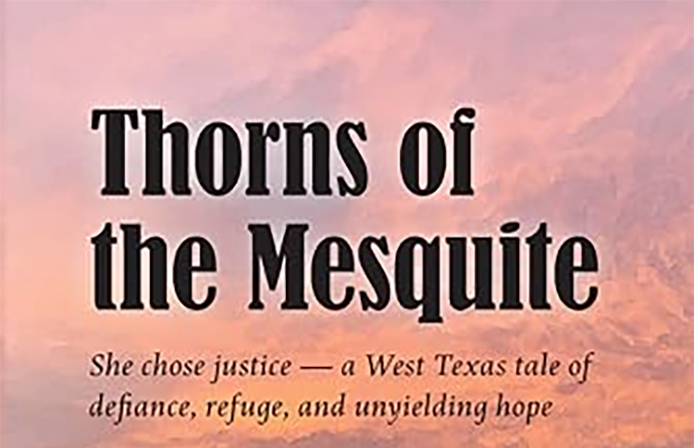
The struggle for justice through love and forgiveness in a harsh land
Thorns of Mesquite by Patricia Lee Lewis is a novel that paints the world of West Texas in the 1930s vividly using sights, smells, and sounds as well as through a complex web of characters. Using a large and diverse cast, Lewis lays out for the reader the issues of gender and race that rocked the twentieth century (and continue today). This might sound like a grand, ambitious undertaking—which it is—but Lewis pulls it off.
The book revolves around Dona, a ranch woman in her late 30s. The book opens slowly, showing the reader how Dona is tied to the land, a West Texas ranch she inherited from her father and now runs with her husband. When a Black man in the community is nearly lynched by the KKK, Dona takes action to defend him. Her actions cascade into a war that threatens to rip apart her family and the community.
This is a book about subjugation of the weak by the powerful, through physical and emotional violence, and about how the stories told by those in power (elected officials, heads of household, religious authority) are used to control women and non-white people. Dona uses the quiet power of listening to another person’s private pain and forgiveness as an act of healing to expose lies and secrets. In doing so, she puts her life and the lives of her family in danger.
It is easy to paint racists in black and white, but Lee builds complexity into all her characters, even those who carry out despicable acts. In particular, she shows how these characters are crippled by the cruelties that they visit on other people, which is an aspect of oppression that is often overlooked in literature. In the end, Dona succeeds not merely by fighting back but by understanding her enemies and building bridges based on shared experience.
This is Lee’s first novel, but she has published poetry for many decades. Her descriptions often soar off the page as in the following, written near the end of the book as Dona tries to make sense of a heartbreaking loss: “It was the hour when coyotes sniffed the river, hoping the catfish would whisper through their whiskers the secret to breathing underwater.” And there is much delicious food, including biscuits and peach preserves, which made me salivate. But she does more than write beautiful descriptions. Lee’s ability to write action scenes makes the book a page-turner; the book is not for the squeamish as the author does not shy from writing about violence in detail. However, forgiveness is meaningful only when there is something significant to forgive.
It’s not easy to find resolution for the conflicts and moral issues raised with in the book. I was not entirely convinced by the reversals of some of the characters at the end of the book. Nevertheless, the book does not try to wrap up everything too neatly, acknowledging in the end that the struggle for equality and justice will continue.
Comments are closed